
Slow Progress-Barriers
Where the inquisitive mind meets nature

So far, I have considered our own biographies and how we construct them. Now, I moved on to something that affects each and everyone of us, and how we see ourselves: how we deal with challenges we face.
Head east from my house as the crow flies and the River Spey is one mile away. Walking, it is a few hundred yards more as you cross through Grantown on Spey’s High Street, pass the RAF’s Robson Resilience Centre I first visited in 2001 (although back then it was called the Outdoor Activity Centre), and head down the Old Military Road, established in the 1700s, which connects Coupar Angus, more than 80 miles south of Grantown and Fort George, a miliary fort 30 miles north of Grantown on the Moray Coast.
[Tim’s Notes: These distances are rough measures as I have not walked the route, and I used Google Maps - so please don’t sue me when you decide to walk it and it is, in fact, only 108 miles!]
A wooded area hugs the bank of Spey between the Old Bridge, built in 1754, and the New Bridge, constructed in 1931, and it is here that I came across one of the most thought-provoking metaphors I know that has emerged from the interaction between humans and nature. Within this wood, a small track follows the river’s path on the east side of the Spey, working its way between the trees.
As with all areas like this, trees fall, and sometimes they block a path.
This is the story of two such trees.
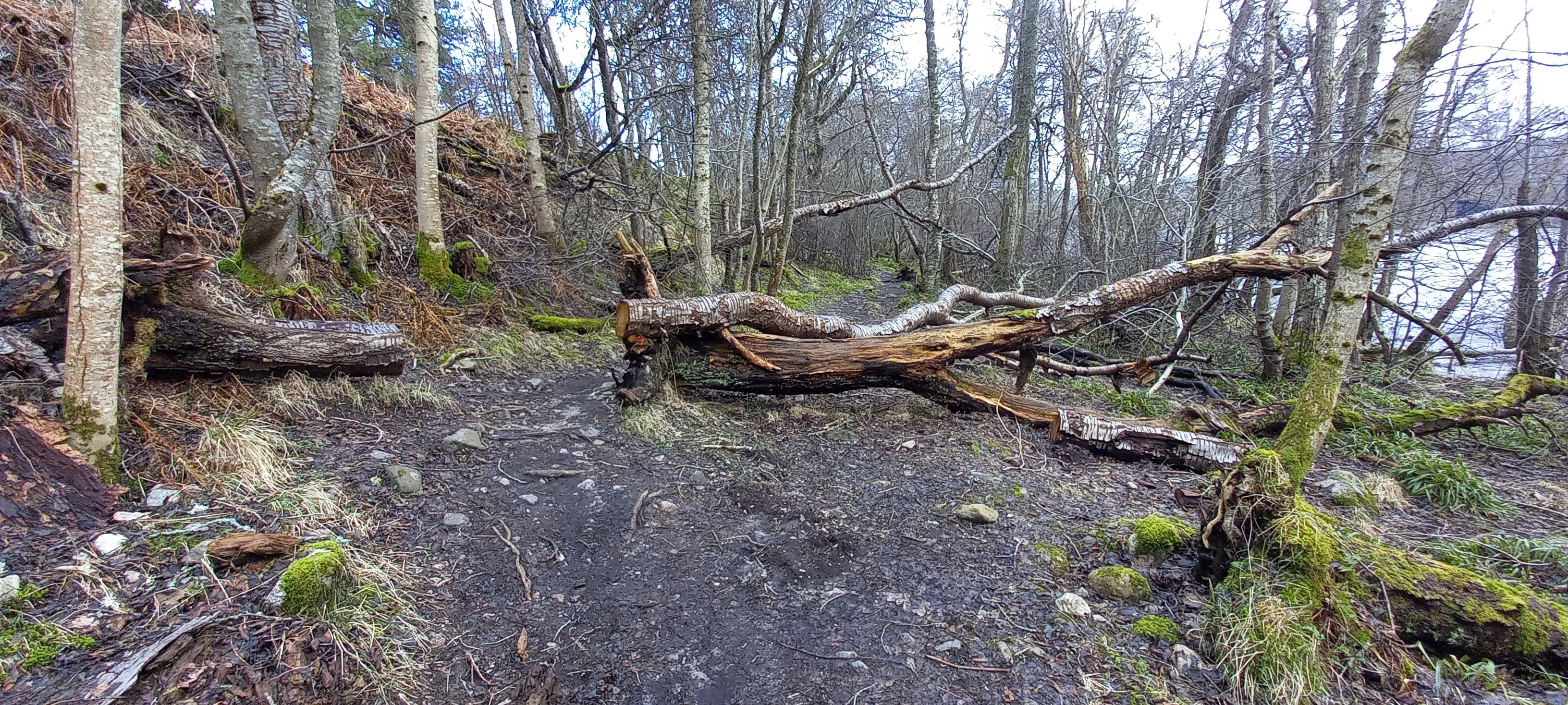
The fallen trees
Some time before we moved to Grantown back in 2018, the path became blocked by a falling tree. It was large enough that the trunk, now fallen, stood about a metre above the ground. Still resting on its now vertical roots, there was a decent gap under the tree where the path remained. However, the upended roots of the tree didn’t push up against the bank so there was a gap to the left. Now, people traveling this path had a choice. Their original route was blocked, yet they could still clamber over the trunk, scramble under the trunk or walk left around the upended roots. Another option was to turn back. Looking at the now present path, it appears that taking the small detour around the upended roots was the most popular option. And this remained ‘the way,’ until about 2021 when another tree selfishly fell across this new path!
[Tim’s Notes: I am not sure the tree really was acting selfishly, but hey, I am sticking to that as it helps the story!]
The new path had been forged between the upended roots of the first tree and a steep bank up to a metalled road. This second tree had fallen from further up the bank and landed on top of the first fallen tree. Now, the newer path was blocked with a fallen tree. Walking around these newly upended roots was possible, but more challenging because it would mean scrambling up the muddy bank. To continue you could clamber over the two trees, duck under the trunks, or turn back. I have no idea how many people now turned back, but the choice for our family and friends was always to clamber over (normally the adults) or scramble under (normally the kiddies). The dogs did whatever took their fancy, which quite regularly included jumping in the river!
This ‘new normal’ continued for a number of years until something unexpected happened.
The unexpected ignites the mind
In 2023, I walked the route, expecting to climb over the trunks – and someone had cut away a metre-long block of the trunk and thrown it off the path – so allowing people to walk along the updated route again.
Until this happened, I will stick my hands up and tell you that I walked this route blissfully ignorant to what this path could offer me in terms of learning.
[Tim’s Notes: Yes, I know, another acknowledgement that I am actually human and not all-seeing, all-knowing… Maybe this is a good time to revert to Chuck D’s seminal advice - “Don’t believe the hype!”]
Yet now my mind was alive with thoughts!
[Tim’s Notes: This isn’t necessarily unusual, but what was unusual was that the thoughts were useful and wouldn’t get me banned from X (previously Twitter!)]
I stood back and looked for the original path. This, whilst much fainter than the current path, was still discernible.
I noticed how well defined the new track was around the upended roots of the first fallen tree.
I reflected on how many times I had, unquestioningly, climbed over the 2 fallen trees to continue on my way.
And, I marvelled at the fact that someone had thought of and made the decision to bring what was probably a chainsaw here and cut away the second fallen truck – so allowing unfettered access, once again, along the path.
Now consider the possible actions that you could take in these circumstances when presented with a new, unexpected barrier. What would you have done?
Normally I will be someone who enjoys the challenge of climbing an unforeseen barrier or forging a new path. If I have a proverbial chainsaw I will seek to remove a barrier, particularly if it is helpful for others – and, whilst I might enjoy real life climbing over tree trunks, in business or most of my life I am self-confessed lazy sod, so am more than happy to take a chainsaw to something. And, because life isn’t as simple as what you see on social media from so-called Influencers who state, ‘I ALWAYS DO THIS!’ sometimes I do turn back.
In the end, it will depend on the situation, yet by considering these issues I am better equipped at understanding why I might act in the way that I do.
What about you?
Would you turn back when the tree had fallen because the path was blocked and you didn’t feel comfortable or confident to forge a new one?
Would you have clambered over the fallen trunk because this would allow you to stay on your original path?
Would you forge a new path, looking for the path of least resistance, whilst enabling you to get to your original destination?
Would you get your chainsaw and cut through the trunk?
It is unlikely you will be presented with such a specific barrier in your personal or professional life, yet this metaphor provides you the opportunity to consider how you respond to barriers as you journey through life.
As you get outside, be open to identifying and considering questions such as:
Do I recognise the barrier for what it was?
How have I reacted to barriers in my life so far?
Do I turn back, struggle over, forge a new path or cut through with a chainsaw?
What behaviour is valued in your team, organisation, family and culture?
What I still don’t know is why the person with the chainsaw cut through the second fallen trunk but hadn’t done so for the first trunk.
My guess is that they moved to Grantown after the first tree had fallen and the new path had been forged. Or, maybe they had only recently bought a chainsaw or got it for Christmas.
[Tim’s Notes: What a gift that would be to unwrap – preferably not plugged into the mains, obvs!]
